
AI Self-Study Roadmap & Timeline Estimator
Data Literacy
Weeks 1-4Load, clean, and explore data. Master Pandas and basic plotting.
Classical ML
Weeks 5-12Scikit-learn, regression, decision trees, and model metrics.
Deep Learning
Weeks 13-20PyTorch, neural networks, CNNs, and image recognition basics.
Specialization
Weeks 21+NLP, Transformers, or advanced vision. Building unique portfolio projects.
Estimate Your Timeline
Estimated Duration:
--
Select phases to see estimate
Start by selecting at least one phase from the roadmap on the left.
It is June 2026, and the question "Can I learn AI myself?" gets asked more often than ever. The short answer is yes. You do not need a PhD or a fancy university degree to start building intelligent systems today. However, the long answer requires some hard truths. Learning artificial intelligence on your own is less about watching videos and more about doing the work. It demands discipline, a willingness to fail repeatedly with code, and a clear roadmap.
The barrier to entry has never been lower. Free resources are abundant. Yet, the completion rate for online AI courses remains painfully low. Why? Because most people underestimate the math foundation and the coding practice required. If you are ready to commit to a structured self-study plan, you can build a portfolio that rivals graduates from expensive bootcamps. Here is how to navigate the landscape without getting lost in information overload.
The Reality Check: What Does "Learning AI" Actually Mean?
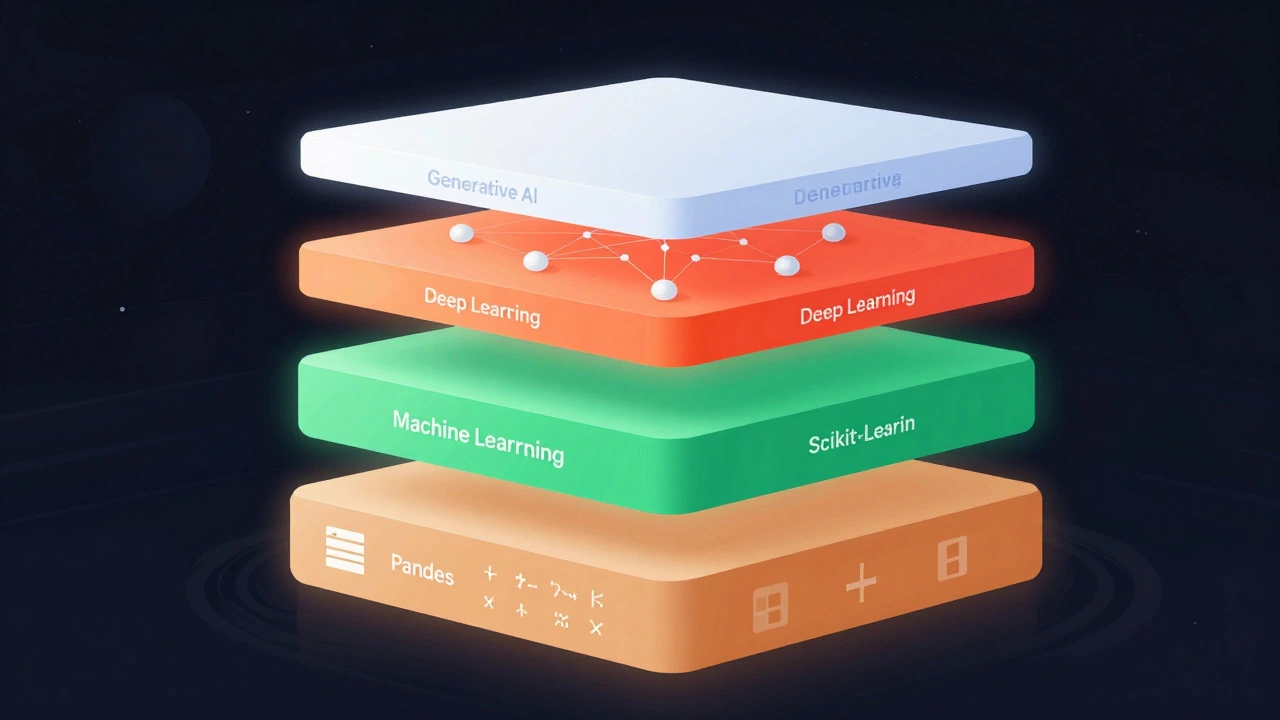
Before you sign up for anything, you need to define what you mean by AI. The term is used loosely in marketing. In reality, Artificial Intelligence is a broad field of computer science focused on creating systems capable of performing tasks that typically require human intelligence. For a self-learner, this usually breaks down into three distinct paths:
- Machine Learning (ML): Algorithms that improve through experience. This is the core of most modern AI applications, like recommendation engines or spam filters.
- Deep Learning (DL): A subset of ML using neural networks with many layers. This powers image recognition, voice assistants, and large language models.
- Generative AI: Systems that create new content, such as text, images, or code. This has seen explosive growth since 2023.
Most beginners want to jump straight to Generative AI because it looks cool. But if you skip the fundamentals of Machine Learning, you will hit a wall quickly. You won't understand why a model fails, how to fix it, or how to optimize it. Start with the basics. Build the foundation first.
The Non-Negotiable Foundations: Math and Code
You cannot fake the math. You don't need to be a mathematician, but you must understand the concepts behind the algorithms. When an algorithm makes a prediction, it is doing math. If you treat these formulas as black boxes, you will struggle to debug your models later.
Focus on these four areas:
- Linear Algebra: Understand vectors, matrices, and dot products. Neural networks are essentially giant matrix multiplications. If you don't get this, deep learning will make no sense.
- Calculus: Specifically, derivatives and gradients. These concepts explain how models "learn" by minimizing errors. You need to understand gradient descent intuitively.
- Probability and Statistics: Data is noisy. You need to know how to handle uncertainty, calculate means, variances, and understand distributions like the normal distribution.
- Python Programming: Python is the lingua franca of AI. You should be comfortable with data structures, functions, and object-oriented programming before touching any AI library.
Do not spend years studying pure theory. Learn just enough math to understand the code. Use resources like Khan Academy for math and freeCodeCamp for Python. Apply what you learn immediately by writing small scripts.
Choosing Your Tools: The Modern AI Stack
In 2026, the tooling landscape is mature but still evolving. You need to pick the right tools to avoid wasting time on deprecated libraries. Here is the standard stack for a self-taught learner:
| Category | Tool/Library | Why It Matters |
|---|---|---|
| Language | Python | Dominant ecosystem support, easy syntax, vast community. |
| Data Manipulation | Pandas & NumPy | Essential for cleaning and preparing data before modeling. |
| Visualization | Matplotlib & Seaborn | Helps you understand data patterns and model performance. |
| Machine Learning | Scikit-learn | Best for traditional ML algorithms like regression and clustering. |
| Deep Learning | PyTorch | Industry standard for research and production; flexible and intuitive. |
| Notebooks | Jupyter / Google Colab | Interactive environment for experimenting with code and visualizations. |
Notice that TensorFlow is missing from the top spot. While still widely used, PyTorch has become the preferred choice for both academia and industry due to its dynamic computation graph and ease of debugging. As a beginner, starting with PyTorch will make your learning curve smoother and your resume more relevant.
The Learning Path: From Zero to Portfolio
Structure is your best friend when learning alone. Without a syllabus, it is easy to bounce between tutorials without retaining anything. Follow this phased approach:
Phase 1: Data Literacy (Weeks 1-4)
Learn to load, clean, and explore data. Most real-world data is messy. Spend time mastering Pandas. Practice loading CSV files, handling missing values, and creating basic plots. Find datasets on Kaggle or UCI Machine Learning Repository. Do not build models yet. Just understand the data.
Phase 2: Classical Machine Learning (Weeks 5-12)
Move to Scikit-learn. Implement linear regression, logistic regression, decision trees, and random forests. Understand metrics like accuracy, precision, recall, and F1-score. Learn about overfitting and underfitting. Build a simple project, like predicting house prices or classifying emails as spam.
Phase 3: Deep Learning Basics (Weeks 13-20)
Switch to PyTorch. Learn about tensors, autograd, and neural network modules. Build a simple feedforward neural network. Then move to Convolutional Neural Networks (CNNs) for image data. Train a model to recognize handwritten digits (MNIST dataset). This is the "Hello World" of deep learning.
Phase 4: Specialization and Projects (Weeks 21+)
Choose a niche. Interested in text? Study Natural Language Processing (NLP) and transformers. Interested in vision? Dive deeper into CNNs and object detection. At this stage, stop following tutorials. Start building your own projects. Solve problems that interest you.
Where to Find Quality Resources
The internet is full of noise. Filter for signal. Here are curated resources that have stood the test of time:
- Coursera: Andrew Ng's Machine Learning Specialization is the gold standard for beginners. It explains concepts clearly without overwhelming math initially.
- Fast.ai: Offers a practical, top-down approach. You build working models first, then dive into the theory. Great for coders who learn by doing.
- Kaggle: Not just for competitions. Their micro-courses are excellent for quick skill checks, and their forums provide community support.
- Hugging Face: The go-to platform for NLP and generative AI. Their documentation and course are invaluable for modern AI development.
- YouTube: Channels like Sentdex, Two Minute Papers, and Yannic Kilcher provide updates and tutorials. Use them to supplement, not replace, structured courses.
Avoid paying for expensive bootcamps unless you need career services and accountability. The technical knowledge is available for free. Your money is better spent on computing power (cloud GPUs) or books.
Building a Portfolio That Gets You Hired
Employers do not care about certificates. They care about what you can build. A self-taught learner must prove competence through a portfolio. Here is how to make yours stand out:
- Go Beyond Tutorials: Do not include the Titanic survival prediction or Iris flower classification in your portfolio. Everyone has those. Create unique projects. Scrape your own data. Solve a local problem.
- Show Your Process: Write blog posts explaining your projects. Discuss the challenges you faced, how you chose your model, and why certain approaches failed. This demonstrates critical thinking.
- Deploy Your Models: A model in a Jupyter notebook is useless to most businesses. Learn to deploy models using Flask, FastAPI, or Streamlit. Host them on cloud platforms like AWS, GCP, or Heroku. Give employers a link they can click.
- Contribute to Open Source: Look for "good first issue" tags on GitHub repositories related to AI. Contributing shows you can collaborate and read other people's code.
Your GitHub profile is your resume. Keep it clean, documented, and active. Pin your best three projects. Ensure your README files are professional and easy to understand.
Common Pitfalls to Avoid
Self-learning is lonely. You will face moments of doubt. Here are common traps that derail progress:
- Tutorial Hell: Watching endless videos without coding along. You feel productive, but you aren't learning. Break the cycle. Code every day, even if it is just for 30 minutes.
- Skipping Math: Thinking you can learn AI without understanding the underlying principles. You might get away with it for simple tasks, but you will struggle with complex problems. Revisit the math when you hit a conceptual wall.
- Chasing Shiny Objects: Jumping to the latest AI trend every week. Stick to one path for at least six months. Depth beats breadth in the early stages.
- Isolation: Not engaging with the community. Join Discord servers, Reddit communities (like r/MachineLearning), or local meetups. Ask questions. Share your progress. Feedback accelerates learning.
Is a Degree Worth It?
This depends on your goals. If you want to work in cutting-edge research at top tech companies or universities, a Master's or PhD is often required. These roles involve developing new algorithms, not just applying existing ones.
However, for most industry jobs-such as machine learning engineer, data scientist, or AI product manager-a degree is not mandatory. Companies value skills and experience. A strong portfolio and demonstrable expertise can open doors that a diploma cannot. Many successful AI professionals are self-taught or switched careers from fields like physics, economics, or software engineering.
If you already have a bachelor's degree in a quantitative field, you likely do not need another degree. Focus on upskilling. If you are starting from scratch, consider a certificate program for structure, but prioritize building projects.
Staying Updated in a Fast-Moving Field
AI changes rapidly. What was state-of-the-art in 2023 may be obsolete in 2026. To stay relevant, you must cultivate a habit of continuous learning.
- Read Papers: Start with arXiv.org. You do not need to read every paper. Follow summaries on Twitter or newsletters like The Batch by Andrew Ng.
- Follow Leaders: Track researchers and engineers on LinkedIn and Twitter. They often share insights and code snippets before they appear in textbooks.
- Experiment: Try new tools as they emerge. Don't wait for a tutorial. Read the documentation and play around. This builds adaptability.
The ability to learn quickly is more valuable than knowing any specific tool. Frameworks come and go. The fundamental principles of data, statistics, and optimization remain constant.
How long does it take to learn AI on my own?
It varies based on your background and time commitment. If you study part-time (10-15 hours per week), expect 6-12 months to reach a job-ready level in machine learning. Full-time learners (30+ hours per week) can achieve this in 3-6 months. Mastery is a lifelong journey, but employability can be reached relatively quickly with focused effort.
Do I need to know advanced mathematics to start?
You do not need advanced math to start, but you cannot ignore it forever. Basic algebra and high school-level calculus are sufficient to begin. As you progress, you will need to learn linear algebra and statistics to understand how models work. Learn math just-in-time, meaning study the specific concept when you encounter it in your coding projects.
Is Python the only language I need to learn?
For 95% of AI roles, Python is sufficient. It has the best libraries and community support. R is used in academic statistics, and C++ is used for high-performance deployment, but Python is the primary language for development and prototyping. Master Python first before considering others.
Can I get an AI job without a computer science degree?
Yes. Many companies prioritize skills over degrees. A strong portfolio with deployed projects, contributions to open source, and demonstrable problem-solving abilities can compensate for lack of formal education. Highlight your projects in interviews and show your code. Networking and referrals also help bypass strict HR filters.
What are the best free resources for learning AI in 2026?
Top free resources include Andrew Ng's courses on Coursera (audit mode), Fast.ai's practical deep learning course, Kaggle's micro-courses, and official documentation for PyTorch and Scikit-learn. YouTube channels like StatQuest and 3Blue1Brown provide excellent conceptual explanations. Combine these with hands-on practice on platforms like Google Colab.