Data Science 3-Month Feasibility Calculator
Not everyone starts from zero. Your background dictates whether three months is enough to get hired or just enough to get started. Select your current professional background below to generate a personalized roadmap and feasibility assessment based on market realities.
Key Assessment
Recommended Hybrid Strategy
You’ve probably seen the ads. "Become a Data Scientist in 12 Weeks." "Master Python and AI in 90 Days." It sounds like a dream come true, especially if you’re looking to pivot from marketing, finance, or even biology into one of the most lucrative tech roles available today. But here is the hard truth: while you can learn the basics of data science in three months, becoming job-ready usually takes longer. The gap between knowing how to write a line of code and solving complex business problems with data is vast.
So, is it possible? Yes. Is it easy? No. And does it guarantee a six-figure salary immediately? Rarely. This guide breaks down exactly what you can achieve in a quarter, what you will likely miss, and how to structure your learning so that those three months count toward a real career change rather than just another half-finished tutorial.
What You Can Actually Learn in 90 Days
If you treat learning data science like a full-time job-meaning 6 to 8 hours a day, five days a week-you can cover a surprising amount of ground. However, you need to be strategic. You cannot learn everything. You must focus on the "Pareto Principle" (the 80/20 rule): the 20% of skills that deliver 80% of the results in entry-level roles.
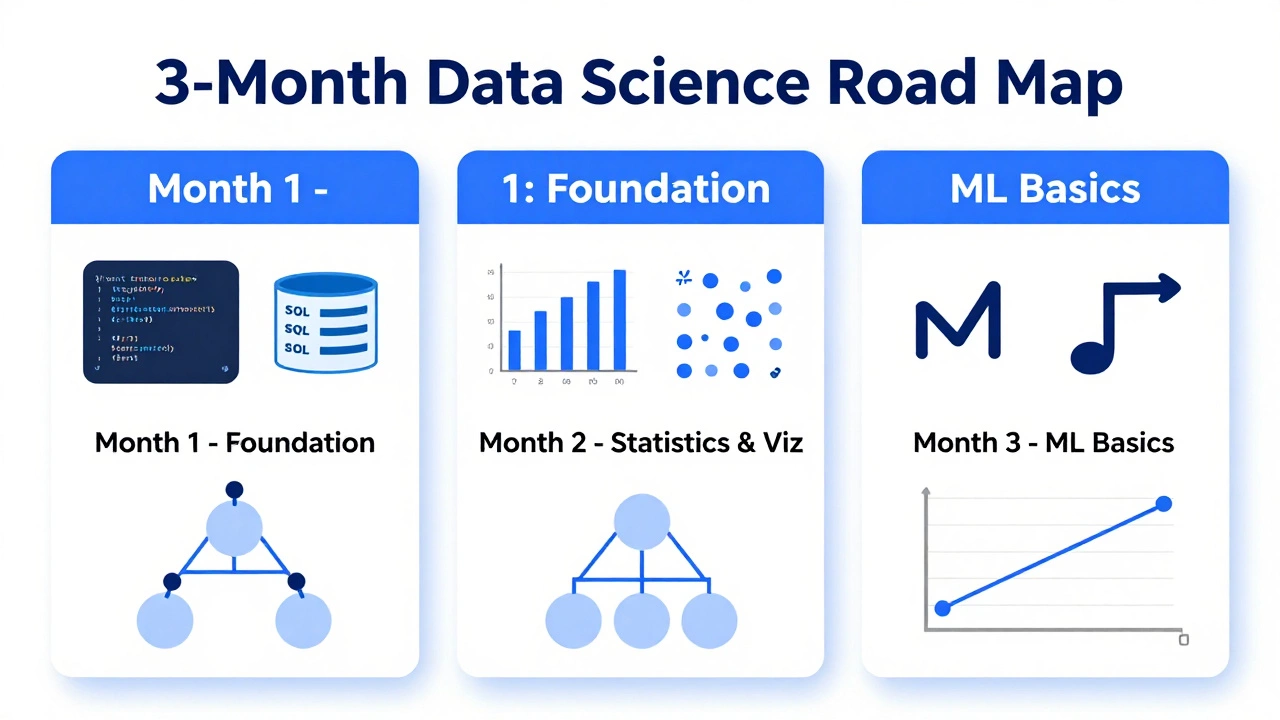
In a strict three-month timeline, your curriculum should look something like this:
- Month 1: The Foundation (Python & SQL). You need to speak the language of data. Focus on Python basics (variables, loops, functions) and libraries like Pandas for data manipulation. Simultaneously, learn SQL. Most companies store their data in databases, not Excel sheets. If you can’t query a database, you can’t analyze the data.
- Month 2: Statistics & Visualization. Coding without statistics is just typing. Understand mean, median, standard deviation, hypothesis testing, and p-values. Then, learn to tell stories with data using Matplotlib, Seaborn, or Tableau. Employers hire data scientists to explain insights, not just calculate them.
- Month 3: Machine Learning Basics & Projects. Dive into scikit-learn. Build simple models: linear regression, logistic regression, and decision trees. Do not obsess over deep learning or neural networks yet. Spend the last two weeks building one solid end-to-end project.
By the end of Month 3, you will have a portfolio piece. You will know how to clean messy data, visualize trends, and build a basic predictive model. That is a respectable start. But let’s talk about where this approach hits a wall.
The Reality Check: Why 3 Months Isn't "Enough" for Most
The problem isn’t the learning speed; it’s the market saturation at the entry level. In 2026, the barrier to entry has shifted. Ten years ago, knowing R or SAS got you an interview. Today, every bootcamp graduate knows Python and TensorFlow. The differentiator is no longer just technical syntax; it’s domain expertise and engineering rigor.
Here are the gaps that a three-month sprint typically leaves wide open:
- Lack of Depth in Mathematics. Understanding *how* a gradient descent algorithm works under the hood takes time. Without this, you become a "library caller"-someone who imports code but can’t debug it when it fails on unique datasets.
- No Engineering Experience. Real-world data science involves version control (Git), cloud platforms (AWS/Azure), and deploying models (Docker/Flask). Bootcamps often skim these because they are harder to teach quickly. Yet, hiring managers expect juniors to at least understand how their code moves from a laptop to a server.
- Weak Business Acumen. Data science is not math; it’s business strategy supported by math. Can you translate a vague request like "increase customer retention" into a measurable metric? Can you explain why a model’s accuracy dropped by 2% to a non-technical stakeholder? These soft skills take experience, not just study hours.
If you rely solely on a three-month course, you risk ending up in the "tutorial hell" trap: watching videos feels productive, but building real solutions feels impossible.
Who Can Make It Work? (And Who Should Wait)
Not everyone starts from zero. Your background dictates whether three months is enough to get hired or just enough to get started.
| Background | Feasibility of 3-Month Pivot | Key Advantage | Main Challenge |
|---|---|---|---|
| Software Engineer | High | Strong coding & Git skills | Statistical theory & ML algorithms |
| Data Analyst | High | SQL & Business context | Advanced Python & Modeling |
| Math/Physics Student | Medium | Strong theoretical foundation | Coding proficiency & Deployment |
| Total Beginner (Liberal Arts/Humanities) | Low | Communication skills | Technical debt & Math gap |
If you are a software engineer, three months might be all you need to transition. You already know how to write clean code, manage projects, and work in teams. You just need to add statistics and machine learning concepts to your toolkit. For data analysts, the jump is also short; you just need to upgrade from descriptive analytics (what happened?) to predictive analytics (what will happen?).
However, if you have no quantitative background, three months is likely insufficient for a direct hire as a "Data Scientist." You might land a role as a Junior Data Analyst first, which is a perfectly valid stepping stone. Trying to force a senior-level title too quickly can lead to burnout and imposter syndrome.
A Smarter Strategy: The "Hybrid" Approach
Instead of asking "Is 3 months enough?", ask "How can I make 3 months the foundation of a 12-month journey?" Here is a more realistic roadmap that balances speed with employability.
Phase 1: Intensive Learning (Months 1-3)
Follow the curriculum outlined earlier. But add one crucial element: Project-Based Learning. Don’t just follow tutorials. Find a dataset on Kaggle or use public government data. Clean it yourself. Struggle with missing values. Visualize it. Build a model. Document your process on GitHub. This portfolio is worth more than any certificate.
Phase 2: Specialization & Networking (Months 4-6)
Now that you know the basics, pick a lane. Do you like healthcare data? Finance? E-commerce? Start reading industry-specific blogs. Attend local meetups or virtual webinars. Connect with data scientists on LinkedIn. Ask them about their day-to-day work. This helps you tailor your resume to specific industries.
Phase 3: Job Hunt & Upskilling (Months 7-12)
Apply for jobs. You will face rejection. Use that feedback. Maybe your SQL queries were inefficient. Maybe your communication during interviews was unclear. Fix those issues. Consider taking a specialized course in Cloud Computing (AWS Certified Data Analytics) or Deep Learning if the market demands it.
This hybrid approach acknowledges that while you can learn the tools quickly, mastering the craft takes time. It also keeps you employed or financially stable while you upskill, reducing the pressure to "get hired now or fail."">
Pitfalls to Avoid in Your First Quarter
I’ve seen many aspiring data scientists stumble over the same rocks. Here is how to avoid them:
- Don’t Learn Every Tool. There is a new framework every week. Stick to Python, SQL, and one visualization tool (Tableau or PowerBI). Master these before chasing shiny objects like Rust or Spark.
- Ignore the "Black Box" Mentality. Never use a library function without understanding what it does. If you don’t know why you standardized your data before running a K-Nearest Neighbors model, you aren’t ready for production.
- Neglecting Storytelling. A model with 99% accuracy is useless if no one understands it. Practice presenting your findings. Record yourself explaining a chart. If you sound confused, your audience will be too.
- Skipping Math Basics. You don’t need a PhD in calculus, but you do need to understand probability distributions. If you skip this, you’ll struggle to interpret model outputs correctly.
Conclusion: It’s a Marathon, Not a Sprint
Is three months enough for data science? It is enough to start. It is enough to build a foundation. It is enough to change your trajectory. But it is rarely enough to become an expert overnight. The field rewards curiosity, persistence, and continuous learning far more than quick certifications.
If you commit to intense, focused study for 90 days, you will be ahead of 90% of casual learners. Combine that with a realistic view of the job market, and you can absolutely break into the industry. Just remember: the goal isn’t to finish the course; the goal is to solve problems. Keep that in mind, and the timeline becomes less important than the progress you make each day.
Can I get a data science job with only 3 months of experience?
It is difficult but possible, especially if you have a related background in engineering, mathematics, or analytics. For total beginners, landing a junior data analyst role first is more realistic. Employers value practical project experience and problem-solving skills over short-term certificates.
Do I need a degree to become a data scientist?
No, a degree is not strictly required. Many successful data scientists are self-taught or come from bootcamps. However, a strong portfolio of projects and demonstrable skills in Python, SQL, and statistics are essential to compensate for the lack of formal education.
What is the best way to learn data science in 3 months?
Focus on the core stack: Python, SQL, and basic Machine Learning. Spend 80% of your time building real projects rather than watching videos. Choose a niche industry to specialize in, and ensure your GitHub portfolio showcases clean, well-documented code.
Is Python or R better for beginners?
Python is generally recommended for beginners due to its versatility, ease of learning, and dominance in the industry. It is used for both data analysis and software engineering tasks, making it more valuable for generalist roles compared to R, which is more specialized for statistical analysis.
How much math do I really need?
You need a solid grasp of high school algebra, basic calculus (derivatives), and probability/statistics. You don’t need to derive algorithms from scratch daily, but you must understand concepts like variance, bias, correlation, and hypothesis testing to interpret results correctly.