
Global Tech Leadership Simulator
*Based on data trends from 2024-2026.
Leadership Ranking
For years, we’ve been told that the United States is the undisputed king of technology. Silicon Valley has long been the gold standard for startups, venture capital, and breakthrough innovations. But if you look closely at the numbers from 2024 through 2026, the picture isn’t so simple anymore. The question “Which country is leading in technology?” doesn’t have a single answer because it depends entirely on what part of the tech ecosystem you’re looking at.
If you measure by raw invention and patent filings, China is pulling ahead. If you measure by commercialization success and high-value software ecosystems, the US still holds the crown. Meanwhile, countries like Germany, South Korea, and Singapore are dominating specific niches like industrial automation and semiconductor manufacturing. To understand who is truly leading, we need to look beyond hype and examine the mechanics of technology transfer, which is the process of moving scientific discoveries from labs into real-world products.
The Patent Powerhouse: China’s Volume Strategy
When people ask about tech leadership, they often point to patents as the ultimate scorecard. In this metric, China is the world's largest filer of intellectual property applications has become undeniable. According to data from the World Intellectual Property Organization (WIPO), China has surpassed the US in total annual patent filings since 2023. By 2025, Chinese entities were filing nearly twice as many patents as their American counterparts.
However, volume is not the same as value. A significant portion of these patents are defensive filings or incremental improvements rather than groundbreaking inventions. The Chinese government has actively pushed this strategy through subsidies and national goals aimed at making the country a global innovation hub by 2035. This approach has created a massive reservoir of technical knowledge, particularly in renewable energy, electric vehicles, and telecommunications infrastructure.
The key takeaway here is that while China leads in quantity, the quality gap is narrowing. Companies like Huawei and BYD are no longer just copying; they are setting standards. For example, in the EV battery sector, Chinese firms control over 60% of the global supply chain, giving them immense leverage in future automotive technologies.
The Commercialization King: The United States’ Ecosystem Advantage
While China files more patents, the United States remains the global leader in converting research into profitable commercial products still wins when it comes to turning ideas into money. The US advantage lies in its mature venture capital ecosystem, strong legal protections for intellectual property, and deep talent pools in universities like MIT and Stanford.
Technology transfer in the US is highly efficient. Universities generate billions in revenue annually from licensing agreements with private companies. Take mRNA vaccine technology, for instance. While the basic science was developed in Europe and the US, it was American biotech firms like Moderna and Pfizer that scaled production and distribution globally within months. This speed-to-market capability is a hallmark of US tech leadership.
In software and artificial intelligence, the dominance is even clearer. Giants like Google, Microsoft, and OpenAI set the agenda for AI development. Even when Chinese researchers publish impressive papers, the infrastructure to deploy those models at scale-cloud computing, chip access, and data centers-is largely controlled by US firms. This creates a bottleneck that limits how far other countries can go without relying on American platforms.
The Industrial Precision Leaders: Germany and South Korea
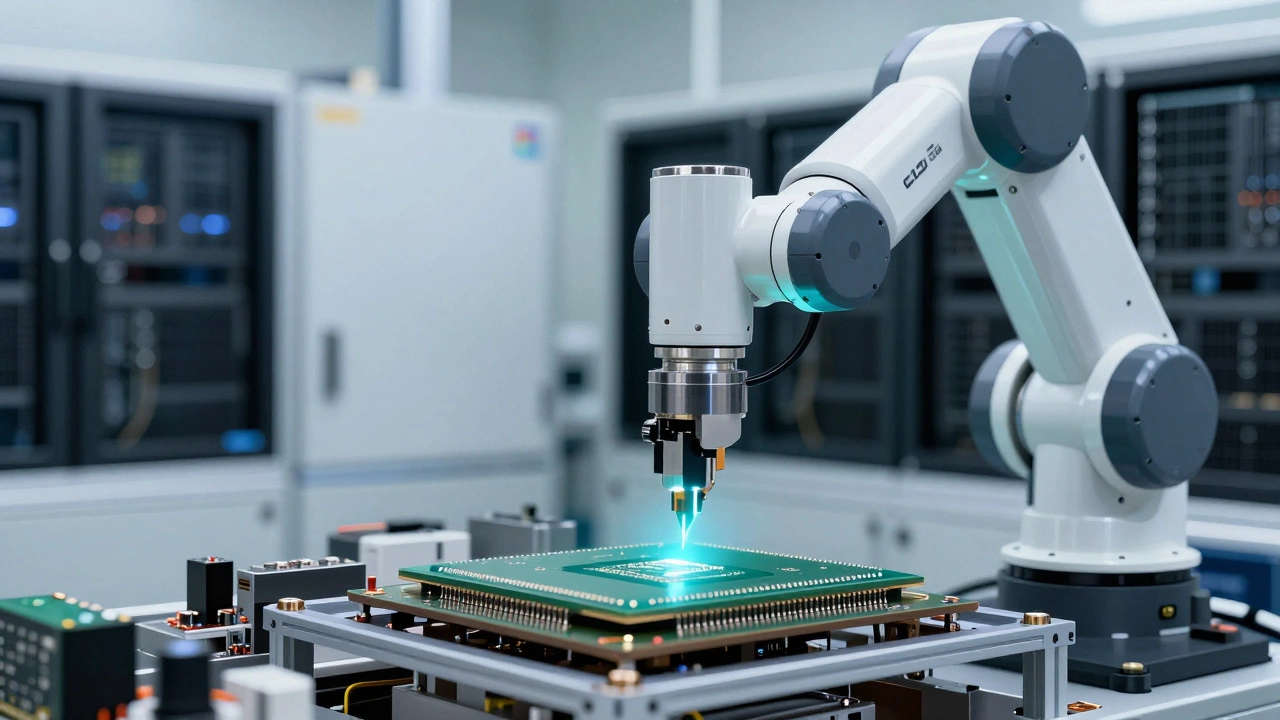
Not all tech leadership looks like Silicon Valley. In hardware and advanced manufacturing, Germany leads in industrial automation and precision engineering and South Korea dominates semiconductor memory and display technologies hold decisive advantages. These nations excel in "Industry 4.0" technologies, where digital systems integrate seamlessly with physical machinery.
Germany’s Mittelstand-small and medium-sized enterprises-are hidden champions in robotics, sensors, and chemical processing. They may not make headlines with consumer apps, but they build the machines that build everything else. Similarly, South Korea’s Samsung and SK Hynix control the majority of the world’s DRAM and NAND flash memory chips. Without these components, neither smartphones nor data centers would function.
This type of leadership is harder to disrupt because it relies on decades of specialized workforce training and tightly integrated supply chains. It’s not enough to write code; you need to manufacture microchips with nanometer-level precision. That’s why these countries remain critical nodes in the global tech network, regardless of who leads in software or patents.
Measuring True Leadership: Beyond Patents and GDP
To determine which country is truly leading, we need better metrics than just patent counts or GDP contributions. Here are three dimensions that matter most in 2026:
- Research Output Quality: Measured by citations per paper and Nobel Prize winners. The US still leads here, followed closely by the UK and Germany.
- Commercialization Rate: The percentage of academic research that becomes a marketable product. The US tops this list, with Israel and Switzerland also performing well.
- Supply Chain Control: Who owns the critical materials and manufacturing steps? China dominates rare earth elements and solar panels, while the Netherlands controls ASML’s lithography machines needed for chipmaking.
No single country excels in all three. The US leads in software and biotech commercialization. China leads in green tech manufacturing and patent volume. Germany and Japan lead in industrial hardware. This fragmentation means that technological leadership is increasingly collaborative-and competitive-at the same time.
| Country | Patent Filings (Annual) | R&D Spending (% of GDP) | Strength Area | Weakness |
|---|---|---|---|---|
| USA | ~600,000 | 3.5% | Software, Biotech, AI | Hardware Manufacturing |
| China | ~1.2 million | 2.5% | EVs, Renewables, Telecom | Core Chip Design |
| Germany | ~70,000 | 3.1% | Industrial Automation | Digital Services |
| South Korea | ~80,000 | 4.9% | Semiconductors, Displays | Basic Research Diversity |
| Japan | ~90,000 | 3.2% | Robotics, Materials Science | Startup Culture |
The Role of Government Policy in Shaping Leaders
Technology leadership isn’t accidental. It’s driven by deliberate policy choices. In the US, laws like the Bayh-Dole Act of 1980 allowed universities to own patents resulting from federally funded research, sparking a boom in tech spin-offs. Today, the CHIPS and Science Act provides billions to reshore semiconductor manufacturing.
In contrast, China uses state-directed funding and five-year plans to prioritize strategic sectors. The government identifies gaps in domestic capabilities and pours resources into closing them. This top-down approach allows rapid scaling but can stifle creativity in areas outside the plan.
European countries take a different route, focusing on regulation and sustainability. The EU’s Green Deal pushes innovation in clean energy, while GDPR shapes how data is used globally. These policies create markets for compliant technologies, influencing where private companies choose to invest.

Emerging Challengers: India, Brazil, and Southeast Asia
Don’t overlook the rising players. India is rapidly growing as a hub for software services and generic pharmaceuticals has emerged as a major force in IT services and space technology. With initiatives like Digital India and increased R&D spending, Indian startups are gaining traction in fintech and agritech. Bangalore alone hosts thousands of tech firms contributing significantly to global outsourcing and innovation.
Brazil is leveraging its agricultural base to develop precision farming technologies. Meanwhile, Vietnam and Indonesia are attracting massive investments in electronics assembly and battery production. These countries may not lead in core R&D yet, but they are becoming essential links in the global tech supply chain.
What Does This Mean for You?
If you’re an entrepreneur, researcher, or investor, understanding this landscape helps you decide where to focus your efforts. Want to build a software platform? Look to the US or Israel. Need to manufacture hardware? Consider Germany, Japan, or South Korea. Looking for growth markets in green tech? China and India offer huge opportunities.
The era of one-country dominance is over. Future leaders will be those who can collaborate across borders while protecting their core competencies. Technology transfer is no longer just about exporting goods-it’s about sharing knowledge, adapting solutions, and building resilient networks.
Is the US still the best place for tech startups?
Yes, for software and biotech, the US remains unmatched due to its venture capital depth and regulatory clarity. However, for hardware manufacturing or cost-sensitive scaling, countries like China, India, and Vietnam offer compelling alternatives.
Why does China file so many more patents than the US?
China’s patent system encourages high-volume filings through subsidies and corporate incentives. Many patents are filed defensively to block competitors or meet government targets, rather than representing unique inventions. This strategy builds a broad IP portfolio but varies in quality.
Which country leads in artificial intelligence development?
The US currently leads in foundational AI models and cloud infrastructure, thanks to companies like Google, Microsoft, and NVIDIA. China is close behind in applied AI, especially in facial recognition and surveillance tech, supported by vast datasets and state backing.
How important is technology transfer for economic growth?
Extremely. Technology transfer bridges the gap between academic research and commercial application. Countries with efficient transfer mechanisms, like the US and Germany, see higher returns on R&D investment, creating jobs and driving productivity gains across industries.
Can smaller countries compete in the global tech race?
Yes, by specializing in niche areas. Israel excels in cybersecurity, Denmark in wind energy, and Switzerland in pharmaceuticals. Smaller nations succeed by fostering tight-knit ecosystems, investing heavily in education, and forming strategic international partnerships.