Biotech Career Pathway Calculator
Configure Your Profile
Configure your profile and click "Analyze My Path" to see your roadmap.
You don’t need a PhD to start a career in biotechnology is a field that uses living systems and organisms to develop or make products. That’s the biggest myth holding people back. The reality is much more layered. Depending on whether you want to pipette samples, analyze genomic data, or lead a drug discovery team, your educational path changes completely.
The industry is booming. With advancements in CRISPR, mRNA vaccines, and personalized medicine, companies are hiring at all levels. But "most" biotech careers require different things. Let’s break down exactly what you need to study, where you can start, and how to move up without getting stuck in endless academia.
The Entry Level: Associate’s Degree and Certifications
If you want to get into the lab quickly, an associate’s degree is your fastest ticket. Many community colleges offer two-year programs in laboratory technology is practical training for operating scientific equipment and conducting basic experiments. This prepares you for roles like a Laboratory Technician or Quality Control Analyst.
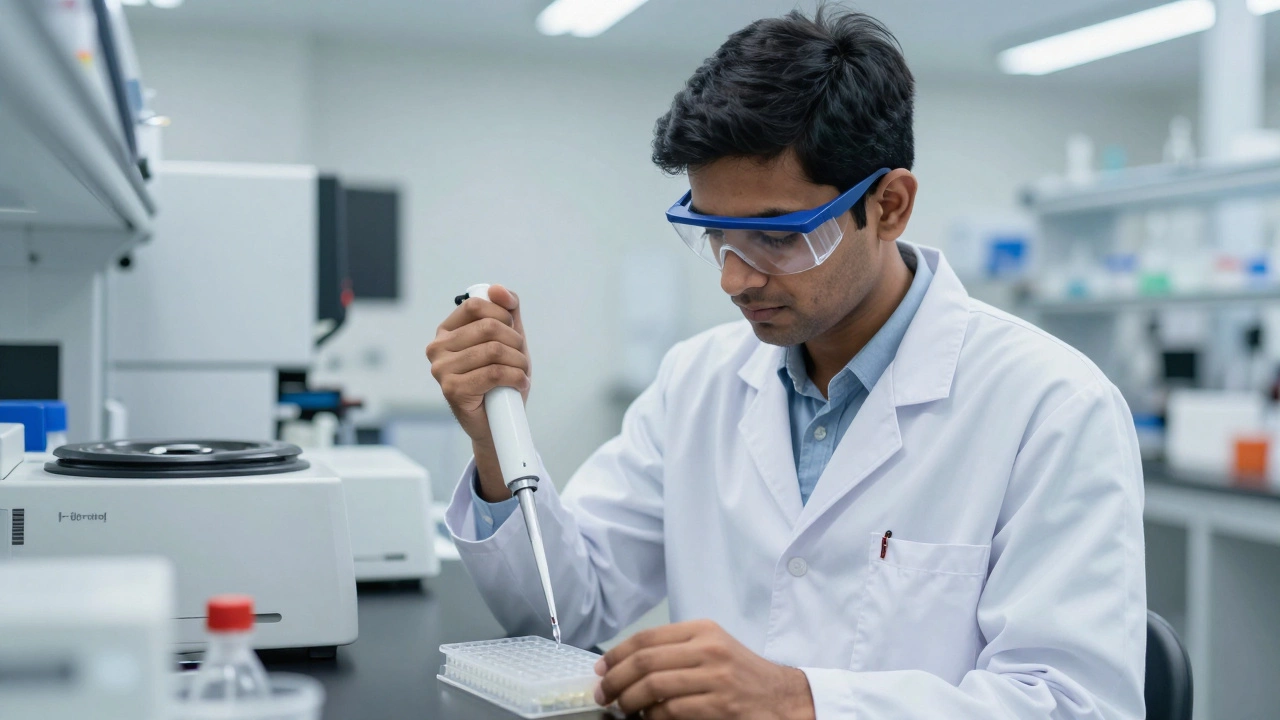
In these roles, you’re the hands of the operation. You prepare media, calibrate centrifuges, and ensure that every sample is handled according to strict protocols. It’s not glamorous, but it’s essential. Without technicians, researchers couldn’t focus on discovery. In Bangalore alone, hundreds of contract research organizations (CROs) hire fresh graduates with diplomas or associate degrees for these positions.
- Typical Roles: Lab Technician, Production Associate, QC Analyst.
- Education Needed: Associate’s degree in Biotechnology, Microbiology, or a specialized certification.
- Time to Hire: 2 years after high school.
- Key Skill: Precision, following Standard Operating Procedures (SOPs), and attention to detail.
This path is perfect if you love working with your hands and prefer structured tasks over open-ended research. You can also enter through vocational training programs that focus specifically on Good Manufacturing Practices (GMP), which are critical in pharmaceutical production.
The Mid-Level: Bachelor’s Degree (The Industry Standard)
For most entry-to-mid-level professional roles, a bachelor’s degree is the baseline. A Bachelor of Science in Biotechnology is a four-year undergraduate program covering biology, chemistry, and engineering principles opens doors to roles in research support, sales, regulatory affairs, and junior project management.
Here’s the catch: just having the degree isn’t enough. The job market is competitive. Employers look for practical experience. Did you intern at a startup? Did you work on a capstone project involving PCR techniques is Polymerase Chain Reaction, a method used to amplify DNA sequences? These details matter. In India, many students graduate with theoretical knowledge but lack wet-lab skills. If you can demonstrate proficiency in cell culture or chromatography during your undergrad, you stand out immediately.
Bachelor’s holders often find success in non-research roles too. Think about medical sales, technical writing, or regulatory compliance. These jobs require understanding the science but don’t always require leading experiments. They pay well and offer stability, especially in growing markets like Southeast Asia and India.
| Education Level | Typical Job Titles | Primary Focus | Average Time to Complete |
|---|---|---|---|
| Associate’s / Diploma | Lab Technician, QC Analyst | Execution & Maintenance | 2 Years |
| Bachelor’s (BS/BSc) | R&D Associate, Sales Rep, Regulatory Specialist | Support & Application | 4 Years |
| Master’s (MS/M.Tech) | Project Manager, Bioinformatician, Senior Scientist | Analysis & Strategy | 5-6 Years Total |
| PhD | Principal Investigator, R&D Director, VP of Science | Innovation & Leadership | 8+ Years Total |
The Advanced Tier: Master’s Degrees and Specialization
A master’s degree allows you to pivot or specialize. Maybe you loved the coding part of your bioinformatics elective. An MS in Bioinformatics is the application of computer science to biological data analysis can transform you from a bench scientist into a data-driven researcher. This is one of the hottest areas right now. With the rise of AI in drug discovery, companies need people who speak both "biology" and "Python."
Other popular specializations include Molecular Biology, Immunology, and Fermentation Technology. In manufacturing-heavy hubs, a master’s in Bioprocess Engineering is gold. It bridges the gap between small-scale lab results and large-scale industrial production. If you want to move into management or lead small teams, a master’s is often the tipping point.
Consider this: if you have a bachelor’s and three years of experience, you might hit a ceiling. A master’s degree resets that clock, giving you access to higher-level strategy roles and significantly higher starting salaries. In regions with strong tech-bio integration, like Silicon Valley or Bangalore’s Electronic City, this hybrid skill set is highly valued.

The Research Track: When You Need a PhD
Not everyone needs a doctorate, but if you want to design original experiments, publish papers, or run your own lab, a PhD is non-negotiable. A Doctor of Philosophy in Biotechnology is an advanced research degree requiring original contribution to scientific knowledge typically takes 4-6 years after a bachelor’s or master’s. It’s intense. You’ll spend years focusing on a single question, failing repeatedly, and learning resilience.
However, the landscape is shifting. Pure academic posts are scarce. Most PhDs now end up in industry R&D, clinical development, or as scientific founders. The value of a PhD today lies in its depth of expertise. If you’re working on gene therapies or novel protein structures, companies need someone who understands the nuance at a molecular level. You can’t learn that in a textbook; you learn it by doing.
Also, consider the opportunity cost. Four years in a PhD program means four years of lower income compared to peers entering the workforce. Make sure your passion for discovery outweighs the financial delay. For many, the intellectual freedom makes it worth it. For others, a master’s plus industry experience offers a better return on investment.
Skill Gaps: What Schools Don’t Teach
Your degree gets you the interview. Your skills get you the job. There is a persistent gap between academic curricula and industry needs. Here’s what you should supplement your education with:
- Data Literacy: Even wet-lab scientists need to handle data. Learn Excel deeply, then move to R or Python. Basic statistical analysis is expected at almost every level.
- Regulatory Knowledge: Understanding FDA or CDSCO guidelines is crucial. If you know how to document processes for audits, you become invaluable.
- Soft Skills: Communication is key. Can you explain complex biological mechanisms to a marketing team or an investor? Write clearly. Present confidently.
- Project Management: Tools like Asana or Jira are common in biotech startups. Knowing how to track timelines and resources helps you move from individual contributor to leader.
Don’t wait for university to teach you these. Take online courses, join hackathons, or volunteer for student organizations that manage events. These experiences show employers you’re adaptable and proactive.
Alternative Paths and Non-Traditional Backgrounds
You don’t have to follow the straight line. People from chemistry, physics, computer science, and even business backgrounds enter biotech successfully. If you have a CS degree, you can transition into computational biology. If you have a finance background, you can work in biotech venture capital or equity research.
The key is framing your narrative. Highlight transferable skills. A chemist understands reaction kinetics, which applies to enzyme assays. A programmer understands algorithms, which apply to sequence alignment. Be ready to explain why you’re pivoting and what you’ve done to bridge the knowledge gap, such as taking night classes or completing relevant certifications.
Regional Differences and Global Opportunities
Education requirements can vary by region. In the US and Europe, accreditation matters heavily. In emerging markets like India, China, and Brazil, practical experience and networking often weigh more than the prestige of the institution. However, global standards are converging. ISO certifications and GMP compliance are universal languages in biotech.
If you plan to work internationally, ensure your degree is recognized. Some countries require credential evaluations. Also, language skills can be a huge advantage. German, Japanese, and Mandarin speakers are in demand in specific sectors of the global supply chain.
Can I get a biotech job with only a high school diploma?
It is extremely difficult. While some entry-level cleaning or stocking roles exist in labs, they do not lead to professional biotech careers. At minimum, an associate’s degree or a specialized vocational certificate in laboratory technology is required to be considered for technical roles.
Is a PhD necessary for a high salary in biotech?
Not necessarily. While PhDs command high starting salaries in R&D, professionals with bachelor’s or master’s degrees in specialized fields like bioinformatics, regulatory affairs, or medical sales can earn comparable incomes, especially with performance bonuses and stock options in successful startups.
What is the difference between B.Sc. and M.Sc. in biotech careers?
A B.Sc. qualifies you for execution and support roles. An M.Sc. demonstrates specialization and analytical depth, allowing you to take on project leadership, complex data analysis, and strategic planning roles. The M.Sc. is often the threshold for moving from "doing" to "designing" experiments.
Do online degrees count for biotech jobs?
It depends on the role. For theoretical or data-focused roles like bioinformatics or regulatory writing, accredited online degrees are increasingly accepted. For wet-lab roles, employers prefer traditional degrees because they guarantee hands-on training. Hybrid programs that combine online theory with local lab practicums are the best option.
How important are internships for biotech students?
Internships are critical. They provide the practical experience that textbooks cannot. Most new graduates fail to secure jobs because they lack exposure to real-world lab environments. Internships help you build a network, learn SOPs, and often lead to full-time offers directly from the host company.