Innovation Policy Impact Calculator
Estimate Economic Impact
Based on global data: Countries that increased public R&D spending by 1% saw 0.2% to 0.5% GDP growth.
Use this calculator to estimate potential economic impact of your country's R&D investment.
Estimated GDP Growth
Results will appear here
How this works: Based on data from the World Bank and OECD, increasing R&D spending by 1 percentage point typically leads to 0.2-0.5 percentage point GDP growth. This calculator uses the midpoint (0.35%) for estimation.
When you hear the word "innovation," you might think of startups in Silicon Valley or a new smartphone hitting the market. But behind every breakthrough-whether it’s a clean energy tech in Bangalore or a life-saving drug in Berlin-there’s usually a quiet force at work: innovation policy. It’s not flashy. It doesn’t make headlines. But without it, most of the technologies we rely on today wouldn’t exist.
What exactly is innovation policy?
Innovation policy is the set of rules, funding programs, tax incentives, regulations, and public investments that governments use to encourage new ideas, technologies, and businesses. It’s not about picking winners. It’s about creating the right conditions so that innovators-scientists, engineers, entrepreneurs-can take risks and turn ideas into real products or services.
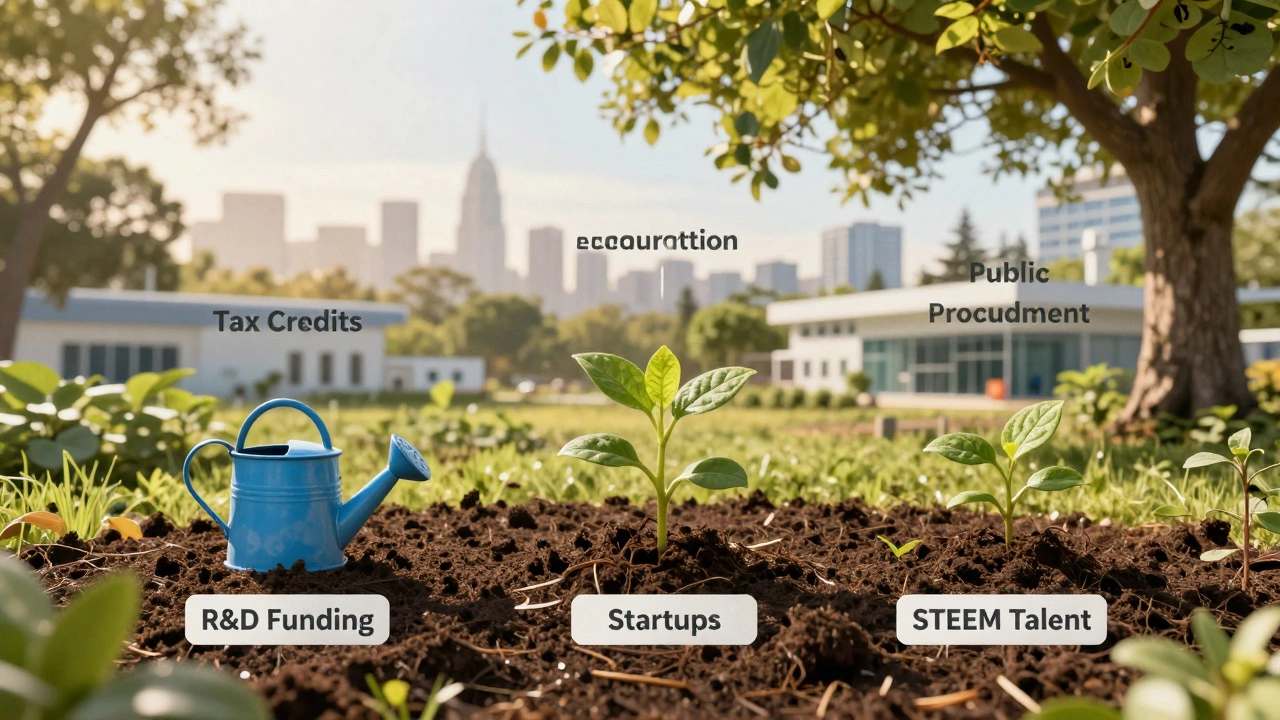
Think of it like gardening. You don’t force a plant to grow. You prepare the soil, give it water, protect it from pests, and give it sunlight. Innovation policy does the same for ideas. It funds research, trains talent, builds infrastructure, and removes barriers so innovation can take root.
How does innovation policy actually work?
It works through five key tools, all working together.
- R&D funding: Governments give grants to universities, labs, and private companies to explore new science. In the U.S., the National Science Foundation spends over $9 billion a year. In India, the Department of Science and Technology supports over 1,200 research projects annually.
- Tax credits: Companies that spend money on research get tax breaks. For example, Canada offers a 35% refundable credit for small businesses doing R&D. India’s Section 35(2AB) gives a 150% deduction for in-house R&D expenses.
- Public procurement: Instead of just buying off-the-shelf products, governments buy new tech to solve public problems. When the Indian government bought electric buses from local manufacturers, it didn’t just reduce emissions-it gave those companies a stable market to grow.
- Regulatory sandboxes: These are safe zones where startups can test new products without full regulatory pressure. The UK’s Financial Conduct Authority started this for fintech. India’s RBI now runs similar sandboxes for digital health and AI in banking.
- Education and skills: Innovation needs people. Policies that fund STEM education, create tech incubators in universities, or offer visas for foreign scientists all feed the pipeline.
Why do governments care so much?
Because innovation drives everything: jobs, health, security, and economic growth.
Between 2010 and 2020, countries that increased public R&D spending by 1% saw an average 0.2% to 0.5% rise in GDP growth. South Korea, which invested 4.8% of its GDP into R&D (the highest in the world), went from a middle-income country in the 1990s to a global tech leader by 2025.
Innovation policy isn’t just about big labs. It’s about small businesses too. In 2023, 68% of India’s startups were founded by first-time entrepreneurs with no venture capital backing. They survived because of government grants, incubation centers in tier-2 cities like Coimbatore and Indore, and simplified patent filing systems.

What does a good innovation policy look like?
It’s not about throwing money at tech. It’s about smart design.
A strong innovation policy is:
- Targeted: Focuses on areas where the country has potential-like India’s push in solar tech, pharma, or AI for agriculture.
- Inclusive: Supports women, rural innovators, and small firms, not just big corporations. Programs like the Atal Innovation Mission in India fund school-level innovation labs in 10,000+ schools.
- Flexible: Adapts as tech changes. Policies from 2010 won’t work for AI or quantum computing in 2026.
- Connected: Links universities, industry, and regulators. In Germany, Fraunhofer Institutes act as bridges between academic research and factory production.
- Measurable: Tracks outcomes, not just spending. Did the grant lead to a patent? A job? A new product sold?
What happens when innovation policy fails?
It’s easy to point to failures. But the real danger is when policy is half-done.
Some countries pour billions into R&D but forget to train engineers. Others create tax breaks but don’t fix the bureaucracy that makes it hard to claim them. In some places, startups get grants but can’t get permits to test their tech.
In India, a 2022 study found that 70% of startups that received government funding couldn’t scale because they lacked access to testing facilities, supply chains, or skilled labor. The policy gave money-but not the ecosystem to use it.
Another common mistake: copying other countries’ policies without adapting them. A policy that worked in Finland for clean energy won’t work in Nigeria if the electricity grid is unreliable. Innovation policy must fit local reality.

Real-world examples: What’s working?
Let’s look at three places doing it right.
Israel: In the 1990s, Israel had no natural resources and little industry. But it launched the Yozma program-a government fund that matched private venture capital 1:1. That led to over 100 venture funds and made Israel the "Startup Nation." Today, it has the highest number of startups per capita in the world.
South Korea: After the 1997 financial crisis, it bet everything on semiconductors and displays. It funded Samsung and LG with low-interest loans, built world-class research parks, and mandated that large firms spend 5% of revenue on R&D. Now, 20% of its GDP comes from tech exports.
India’s Biotechnology Industry Initiative: In 2020, India launched a ₹15,000 crore ($1.8 billion) fund to support domestic biotech firms. It didn’t just give grants-it created shared labs, fast-tracked approvals for biosimilars, and linked startups with public hospitals for clinical trials. By 2025, India became the third-largest producer of vaccines globally.
Where is innovation policy headed in 2026?
Three big shifts are happening:
- From funding to outcomes: Governments now demand proof of impact. Grants require milestones: patents filed, jobs created, products launched.
- Climate innovation as priority: Nearly every major country now ties innovation funding to decarbonization goals. The EU’s Green Deal Innovation Fund is worth €10 billion. India’s Production Linked Incentive scheme now favors solar inverters over fossil fuel tech.
- AI and data as new infrastructure: Just like roads and electricity, governments are treating AI models and open datasets as public goods. The U.S. released 100+ public AI models. India launched the National AI Portal with free tools for startups.
Innovation policy is no longer optional. It’s the backbone of economic survival in a world where technology changes faster than laws can keep up.
What can you do if you’re not a policymaker?
You don’t need to be in government to influence innovation policy.
- If you’re a student: Push your university to offer innovation labs or patent workshops.
- If you’re a founder: Apply for government incubators. They’re often underused and come with mentorship, not just cash.
- If you’re a citizen: Ask your local representative: "What’s our city doing to support local tech startups?" Demand transparency in how innovation funds are spent.
Innovation doesn’t happen in a vacuum. It happens when people, policies, and resources come together. And that’s the real power of innovation policy-it turns individual genius into collective progress.
Is innovation policy only for big countries?
No. Even small countries and cities can build effective innovation policies. Estonia, with a population of 1.3 million, became a global leader in e-governance through focused digital innovation policies. Local governments in India, like Bengaluru and Pune, now run city-level innovation challenges that fund local startups solving traffic, waste, or water problems.
Does innovation policy only help tech companies?
No. It supports innovation in healthcare, agriculture, education, and even public services. For example, India’s Ayushman Bharat digital health platform was built using public innovation funding. Farmers using AI-based soil sensors in Maharashtra got support through state-level agri-innovation grants. Innovation isn’t just about apps-it’s about better ways to do anything.
How is innovation policy different from industrial policy?
Industrial policy picks specific industries to support-like steel or autos-and protects them with tariffs or subsidies. Innovation policy supports the process of creating new things, regardless of industry. It’s about enabling new ideas, not protecting old ones. A country can have both, but innovation policy is more flexible and future-focused.
Do innovation policies always lead to success?
No. Many programs fail because they’re poorly designed, underfunded, or disconnected from real needs. The key is learning from failure. Countries like Singapore and Finland constantly evaluate their programs and kill what doesn’t work. Success isn’t about every grant paying off-it’s about creating a system where good ideas rise naturally.
Can innovation policy reduce inequality?
Yes, if designed well. When innovation funding reaches rural areas, women-led startups, or marginalized communities, it creates opportunity. India’s Innovation in Rural Areas program funds local inventors with mobile apps for irrigation or solar-powered cold storage. These aren’t just tech projects-they’re tools for economic inclusion.