Deep Sea Exploration Simulator
Current Zone: Epipelagic
Sunlight zone where photosynthesis occurs. Most marine life resides here.
Exploration Methods Comparison
| Method | Depth Capability | Cost per Mission | Data Quality | Risk Level |
|---|---|---|---|---|
| Manned Submersible | Up to 11,000m | Very High ($500k+) | High (Human Observation) | High |
| ROV (Remotely Operated) | Up to 6,000m | High ($200k+) | High (Real-time Video) | Low |
| AUV (Autonomous) | Up to 4,500m | Medium ($50k+) | Medium (Sensor Data) | Very Low |
| Satellite Altimetry | Surface Only | Low | Low (Topography Only) | None |
Did You Know?
We have mapped more of the surface of Mars than we have of our own ocean floor. Less than 25% of the global ocean has been mapped with modern sonar technology.
We have mapped more of the surface of Mars than we have of our own ocean floor. It sounds like a sci-fi plot twist, but it is the reality of modern exploration. Despite covering over 70% of the Earth's surface, less than 25% of the global ocean has been mapped with modern sonar technology, and we have physically visited only a tiny fraction of that. You might wonder why, in an age where we send rovers to other planets, we cannot simply dive down and see what is hiding in the dark.
The answer isn't just about money or curiosity. It is about physics, engineering limits, and the sheer hostility of the deep environment. When you push a human or a machine deeper into the water, you are fighting against forces that can crush steel like aluminum foil. Understanding why this barrier exists requires looking at the three main enemies of ocean exploration: pressure, darkness, and distance.
What is the main reason we haven't explored the entire ocean?
The primary reasons are extreme pressure, lack of sunlight, and the high cost and technical difficulty of maintaining equipment and humans at great depths.
The Crushing Weight of Water
Imagine standing at the bottom of a swimming pool. You feel a slight pressure on your eardrums. Now imagine multiplying that pressure by a factor of one thousand. That is what happens at just 1,000 meters (about 3,280 feet) deep. At the deepest point on Earth, the Mariana Trench, the pressure exceeds 1,000 atmospheres. To put that in perspective, it is like having an elephant stand on your thumb.
This physical reality dictates every aspect of deep-sea exploration. Unlike space, which is a vacuum, the ocean is dense. Water does not compress easily, so as you go deeper, the weight of all the water above you pushes down with immense force. Any vessel designed to withstand this must be incredibly strong yet lightweight enough to maneuver. This creates a massive engineering paradox.
Early submarines used steel spheres, but they were heavy and slow. Modern submersibles, like the Triton 36000/2, a bathyscaphe capable of reaching any depth in the ocean, use advanced materials like titanium and acrylic glass. Even then, these vehicles are expensive to build and operate. A single dive can cost hundreds of thousands of dollars. If you want to explore 100% of the ocean, you need thousands of dives, which quickly becomes financially impossible for most governments and research institutions.
Darkness and Communication Blackout
If pressure wasn't enough, there is the issue of visibility. Sunlight penetrates only the top 200 meters of the ocean, known as the epipelagic zone. Below that lies the mesopelagic, bathypelagic, abyssopelagic, and hadal zones. In these areas, it is pitch black. No photosynthesis occurs here, meaning no plants grow. Life survives on organic matter falling from above or through chemosynthesis near hydrothermal vents.
For explorers, this darkness means you cannot rely on eyesight. Submersibles must carry powerful lights, but light scatters in water, creating glare and limiting visibility to just a few dozen meters. It is like driving in thick fog with your high beams on. Furthermore, radio waves do not travel well through water. This makes real-time communication between a submersible and its support ship nearly impossible at great depths. Operators often rely on acoustic modems, which transmit data at speeds slower than dial-up internet from the 1990s. Sending high-definition video or large datasets takes hours, making remote operation frustrating and slow.
This communication gap also affects safety. If something goes wrong deep underwater, rescue operations are extremely difficult. There are no cell towers in the trench. You are isolated in a metal bubble, miles below the surface, relying entirely on your equipment to keep you alive. This psychological and operational isolation adds another layer of complexity to mission planning.
The Scale of the Unknown
The ocean is vast. Covering approximately 361 million square kilometers, it is too big to explore comprehensively with current technology. Mapping the ocean floor requires ships equipped with multibeam sonar, which sends sound pulses to the seafloor and measures the time it takes for them to return. While effective, this process is slow. A single ship might map a few thousand square kilometers per day. At that rate, mapping the entire ocean would take decades, even if we dedicated every available research vessel to the task.
Moreover, the ocean is not static. Currents move sediment, earthquakes reshape trenches, and volcanic activity creates new landforms. What we map today might change tomorrow. This dynamic nature means that "exploring" the ocean is not a one-time event but an ongoing process of monitoring and updating our knowledge.
Consider the analogy of exploring a forest. If you walk through a forest during the day, you see trees, animals, and paths. But if you close your eyes, you miss the insects, the fungi, the roots underground, and the birds in the canopy. Similarly, our current maps show the shape of the ocean floor, but they tell us little about the life forms, chemical compositions, or geological processes happening there. True exploration involves biological sampling, water analysis, and long-term observation, which are far more resource-intensive than simple mapping.
Technological Limitations and Innovation
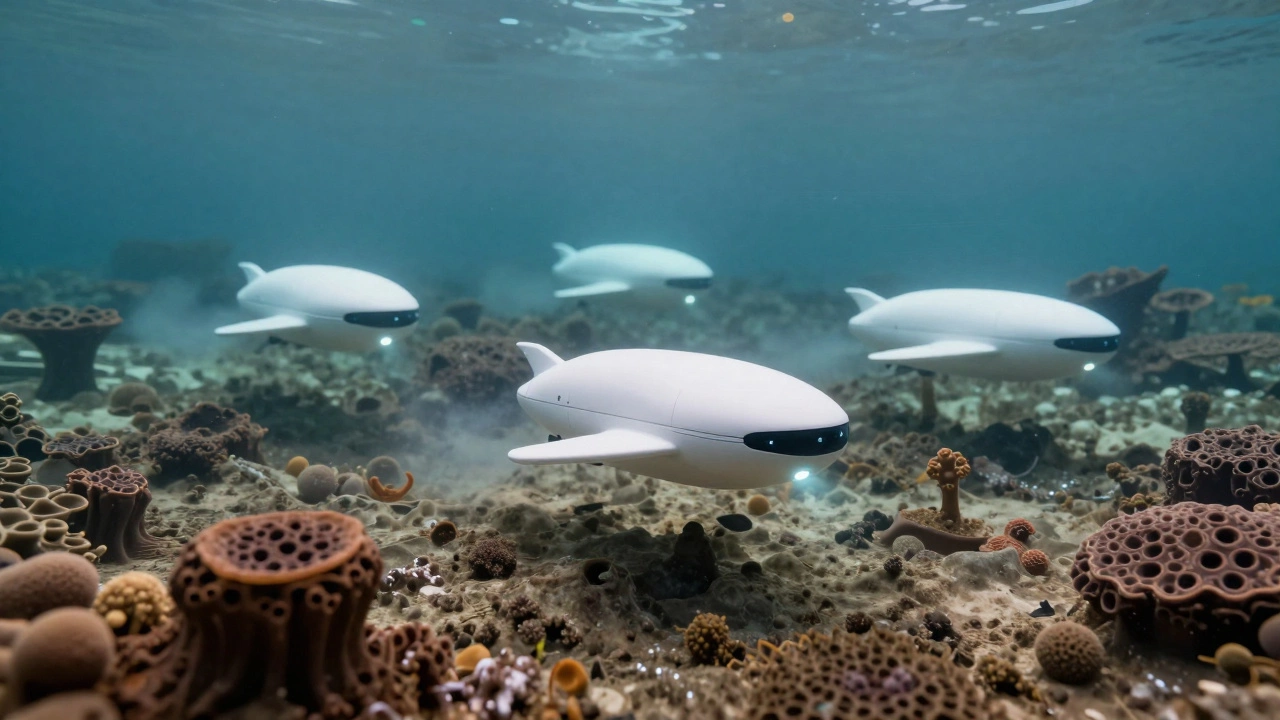
To overcome these challenges, scientists are turning to autonomous systems. Remotely Operated Vehicles (ROVs) and Autonomous Underwater Vehicles (AUVs) can stay underwater for days or weeks without risking human lives. These robots are smaller, cheaper, and more durable than manned submersibles. They can be deployed in swarms to cover larger areas quickly.
One promising development is the use of AI-driven AUVs. Instead of following pre-programmed paths, these vehicles can make decisions based on sensor data. If an AUV detects a hydrothermal vent or a unique geological feature, it can adjust its course to investigate further. This adaptability increases the efficiency of each mission.
However, batteries remain a bottleneck. Underwater charging is difficult, and energy-dense batteries are heavy. Researchers are experimenting with fuel cells and tidal energy harvesting, but these technologies are still in early stages. Until we solve the power problem, the range and duration of underwater missions will remain limited.
| Method | Depth Capability | Cost per Mission | Data Quality | Risk Level |
|---|---|---|---|---|
| Manned Submersible | Up to 11,000m | Very High ($500k+) | High (Human Observation) | High |
| ROV (Remotely Operated) | Up to 6,000m | High ($200k+) | High (Real-time Video) | Low |
| AUV (Autonomous) | Up to 4,500m | Medium ($50k+) | Medium (Sensor Data) | Very Low |
| Satellite Altimetry | Surface Only | Low | Low (Topography Only) | None |
Why Does It Matter?
You might ask, "So what? Why should we care about the deep ocean?" The answer lies in climate regulation, biodiversity, and potential resources. The ocean absorbs about 30% of the carbon dioxide produced by humans and over 90% of the excess heat trapped by greenhouse gases. Without understanding how the deep ocean circulates and stores carbon, we cannot accurately predict future climate change.
The deep sea is also home to millions of undiscovered species. Many of these organisms produce unique chemicals that could lead to new medicines, such as cancer treatments or antibiotics. By failing to explore, we are missing out on potential breakthroughs in healthcare.
Additionally, the seabed contains mineral deposits like polymetallic nodules, rich in manganese, nickel, copper, and cobalt. These metals are essential for electric vehicle batteries and renewable energy infrastructure. As surface resources deplete, mining the deep ocean may become necessary. However, doing so without understanding the ecosystem could cause irreversible damage. Exploration is the first step toward responsible resource management.
There is also a cultural dimension. Humans are naturally curious. We look up at the stars and wonder what is out there. But we also look down into the depths. Exploring the ocean satisfies a fundamental human desire to understand our planet. It reminds us that we are not separate from nature but part of a complex, interconnected system.
The Path Forward
Exploring 100% of the ocean is likely impossible in the literal sense. New features will always emerge, and life will continue to evolve. However, we can aim for comprehensive coverage. Initiatives like the Nippon Foundation-GEBCO Seabed 2030 Project are working to map the entire ocean floor by 2030. This relies on collaboration between governments, private companies, and citizen scientists.
Private sector involvement is growing. Companies are investing in underwater robotics and data analytics. For example, some tech firms are using satellite data combined with AI to infer seabed topography where direct measurements are lacking. While not perfect, this approach accelerates progress.
Education and public engagement are also crucial. When people understand the value of the ocean, they are more likely to support funding for exploration. Schools can incorporate ocean science into curricula, inspiring the next generation of marine biologists, engineers, and policymakers.
Finally, international cooperation is essential. The ocean knows no borders. Disputes over territorial waters and resource rights can hinder exploration efforts. Treaties and agreements that promote open access to data and collaborative research are vital for advancing our knowledge.
In the end, the question is not whether we *can* explore 100% of the ocean, but whether we *should* try. Given the benefits to climate science, medicine, and resource sustainability, the answer is yes. We may never see every corner of the deep, but each dive brings us closer to understanding the blue heart of our planet. And that journey is worth taking.
How much of the ocean has been explored?
Less than 5% of the ocean has been directly observed by humans. About 25% has been mapped with modern sonar technology, but much of this data is low-resolution.
What is the deepest part of the ocean?
The Challenger Deep in the Mariana Trench is the deepest known point, reaching approximately 10,935 meters (35,876 feet) below sea level.
Why is it hard to communicate underwater?
Radio waves attenuate rapidly in water, making wireless communication ineffective. Acoustic signals are used instead, but they have low bandwidth and slow transmission speeds.
What are ROVs and AUVs?
ROVs (Remotely Operated Vehicles) are tethered to a ship and controlled by operators. AUVs (Autonomous Underwater Vehicles) operate independently using pre-programmed instructions or AI.
Can we mine the deep ocean safely?
Currently, there is insufficient data to guarantee safe mining practices. Potential impacts on fragile ecosystems and noise pollution require extensive study before commercial extraction begins.
Who is leading ocean exploration efforts?
Major players include NOAA (National Oceanic and Atmospheric Administration), WHOI (Woods Hole Oceanographic Institution), and international projects like Seabed 2030.
How does ocean exploration help climate change?
By studying ocean currents, carbon absorption, and heat storage, scientists can improve climate models and predict future changes more accurately.
Are there new species discovered in the deep ocean?
Yes, hundreds of new species are discovered annually, including bioluminescent fish, giant squids, and extremophile microbes living near hydrothermal vents.
What is the cost of building a deep-sea submersible?
Building a state-of-the-art deep-diving submersible can cost between $10 million and $50 million, depending on capabilities and materials used.
Is space exploration easier than ocean exploration?
In some ways, yes. Space is a vacuum, so there is no pressure or fluid dynamics to contend with. However, radiation and temperature extremes pose significant challenges in space.