
Data Science Career Path Finder
Not sure where to start? Answer these questions to find your ideal entry-point into data science.
You don't need a PhD in mathematics or ten years of coding to break into data science. In fact, most hiring managers today care less about your degree title and more about whether you can actually solve a business problem with data. If you're sitting there wondering how to pivot from marketing, finance, or even retail into this field without a prior track record, the path is clearer than it looks. It just requires a shift in mindset from "learning everything" to "building proof."
The Myth of the Perfect Candidate
Let's kill a rumor right now: there is no such thing as a perfect entry-level candidate. Companies aren't looking for unicorns who know every algorithm by heart. They are looking for people who can ask the right questions and find answers using tools like Python or SQL.
Think about it. If you worked in sales, you already understand customer behavior. If you were an accountant, you know how to handle messy numbers. These are transferable skills. The gap isn't your background; it's your ability to translate that background into technical execution. You don't need to start from zero; you need to start from where you are.
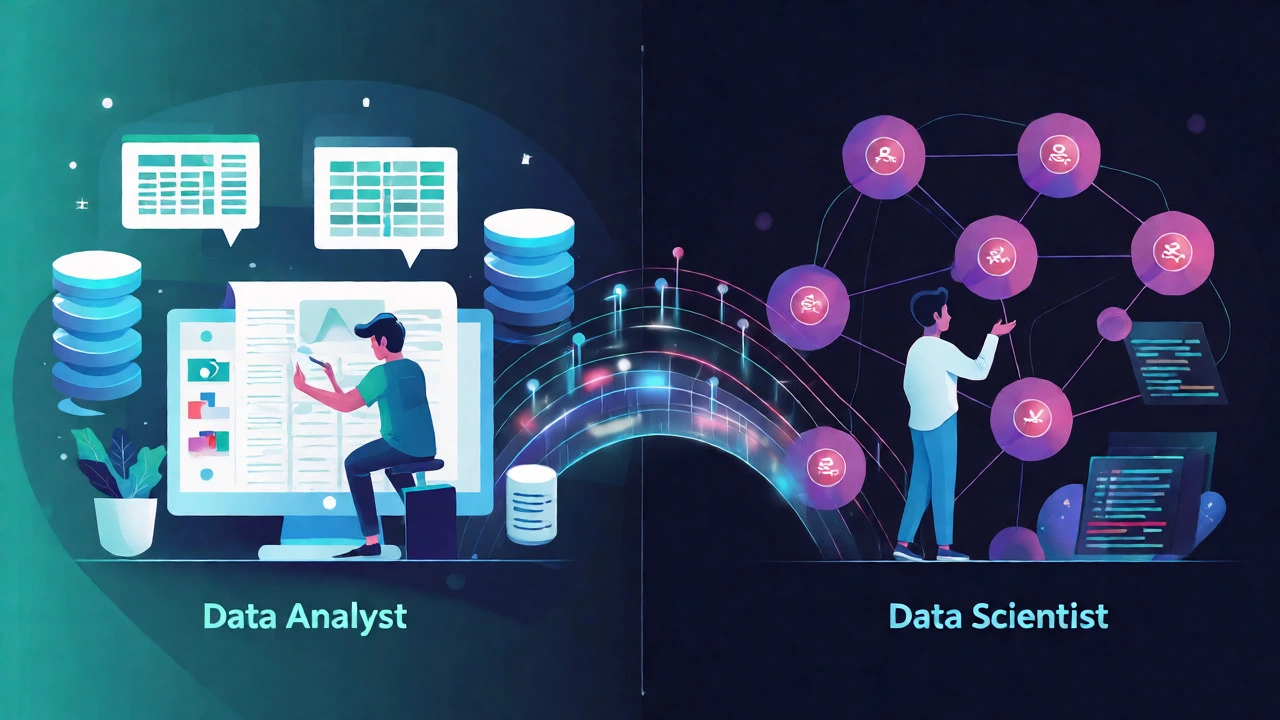
Pick Your Lane: Analyst vs. Scientist
Before you spend six months learning machine learning models you might never use, figure out which role fits your current skill set. This is the biggest mistake beginners make-trying to be a full-stack data scientist on day one.
| Role | Primary Focus | Key Tools | Math Requirement | Best For |
|---|---|---|---|---|
| Data Analyst | Descriptive analytics, reporting, dashboards | SQL, Excel, Tableau/PowerBI | Low (Basic Stats) | Career changers, domain experts |
| Data Scientist | Predictive modeling, ML algorithms | Python/R, Scikit-learn, TensorFlow | High (Linear Algebra, Calc) | STEM backgrounds, coders |
| Data Engineer | Data pipelines, database management | SQL, Python, Apache Spark, AWS | Medium (Logic/Structures) | Developers, IT professionals |
For most people with no experience, starting as a Data Analyst is the smartest move. It gets your foot in the door faster. Once you're inside a company, you can learn the harder stuff on the job while getting paid. Trying to jump straight into a Senior Data Scientist role without a portfolio is like trying to run a marathon before you've learned to jog.
Master the Core Stack (Not Everything Else)
You cannot learn all of data science. There are too many libraries, too many frameworks, and too many new tools popping up every month. Instead, focus on the "Holy Trinity" of entry-level data work: SQL, Excel, and Python.
1. SQL is non-negotiable.
If you only learn one thing, make it SQL. Why? Because data lives in databases. You need to know how to get it out. Learn SELECT, WHERE, GROUP BY, and JOIN. That’s it. That covers 90% of what junior analysts do daily. Don't worry about window functions or complex stored procedures yet. Just get comfortable querying data.
2. Excel is still king. Yes, really. Many companies still run their core operations on spreadsheets. Knowing how to build a dynamic dashboard, use VLOOKUP/XLOOKUP, and create pivot tables makes you instantly useful. It shows you can communicate insights visually without needing code.
3. Python for automation and analysis. Skip the deep computer science theory. Learn enough Python to manipulate data using Pandas and visualize it using Matplotlib or Seaborn. You don't need to write complex classes or understand memory management deeply at first. You need to load a CSV, clean the null values, and plot a bar chart.
Build a Portfolio That Tells a Story
A certificate proves you watched videos. A project proves you can do the work. Hiring managers ignore certificates if they don't see evidence of application. But here’s the catch: don't build another "Titanic Survival Prediction" model. Everyone does that. It’s boring.
Instead, find data that interests you or relates to your previous job. Did you work in retail? Download public sales data and analyze which products sell best during holidays. Were you a teacher? Analyze student performance data against attendance records. Use datasets from Kaggle or government open data portals like data.gov.in.
Your portfolio needs three things:
- A clear problem statement: What question are you answering?
- Clean code: Put your notebooks on GitHub. Add comments explaining why you made certain decisions.
- Business impact: Don't just show accuracy scores. Explain what the insight means. "I found that customers who buy X are 20% likely to buy Y within a week" is better than "My model had 85% accuracy."
Leverage Your Non-Tech Background
This is your secret weapon. Pure CS grads often struggle to understand business context. You already have it. If you were a marketer, you understand conversion funnels. If you were in HR, you understand employee churn. Frame your resume around these connections.
Don't say: "Learned Python and SQL." Do say: "Used SQL to analyze customer retention trends, identifying a 15% drop-off point in the user journey." This shows you’re not just a coder; you’re a problem solver who happens to use code.

Navigating the Job Hunt Without Experience
Applying through online portals is tough when you have no history. Your network is your net worth. Reach out to people already working in data roles. Ask them specific questions: "What tools do you use daily?" or "What was the hardest part of your transition?" Not "Can you give me a job?"
Consider contract or freelance gigs. Platforms like Upwork have small data cleaning tasks. Even doing a free analysis for a local non-profit gives you a real-world constraint and a story to tell. "I helped a local charity optimize their donor outreach using email engagement data" sounds much more impressive than "I completed a Coursera course."
Common Pitfalls to Avoid
Don't fall into "Tutorial Hell." This is when you watch endless tutorials but never build anything yourself. Stop watching after you understand the concept, then try to build it from scratch without looking at the video. If you get stuck, debug it. That struggle is where learning happens.
Also, don't obsess over the latest AI hype. While Generative AI is huge, most entry-level jobs still require solid fundamentals in data cleaning and basic statistics. Mastering the basics will get you hired faster than knowing how to fine-tune a large language model.
Do I need a master's degree to get into data science?
No, not for entry-level roles. While some research-heavy positions prefer advanced degrees, most industry jobs prioritize practical skills and a strong portfolio. Bootcamps, self-study, and relevant certifications combined with proven projects are often sufficient to land a Data Analyst or Junior Data Scientist role.
Is Python better than R for beginners?
For most beginners, Python is recommended because it is versatile, widely used in production environments, and has a gentler learning curve for general programming concepts. R is excellent for statistical analysis and academic research, but Python offers more opportunities in software engineering integration and deployment.
How long does it take to learn data science from scratch?
With consistent effort (10-15 hours a week), you can become job-ready for an entry-level Data Analyst position in 6 to 9 months. Becoming proficient in full-stack Data Science typically takes 12 to 18 months, depending on your prior math and coding aptitude.
What is the most important skill for a beginner?
Communication and storytelling with data. Being able to explain complex findings to non-technical stakeholders is often valued higher than advanced algorithm knowledge for junior roles. Technical skills get you the interview; communication skills get you the job.
Should I learn Machine Learning immediately?
Not immediately. Start with descriptive analytics (SQL, Excel, Basic Python). Most entry-level jobs involve cleaning data and creating reports rather than building predictive models. Add Machine Learning once you are comfortable handling raw data and understanding basic statistics.